Tinker Tailor
8-Bit WS2812 RGB LED Rectangle Module
8-Bit WS2812 RGB LED Rectangle Module
Couldn't load pickup availability
Canadian-owned and packed by hand in Nova Scotia, so there's no cross-border duty or brokerage. Shipping rates
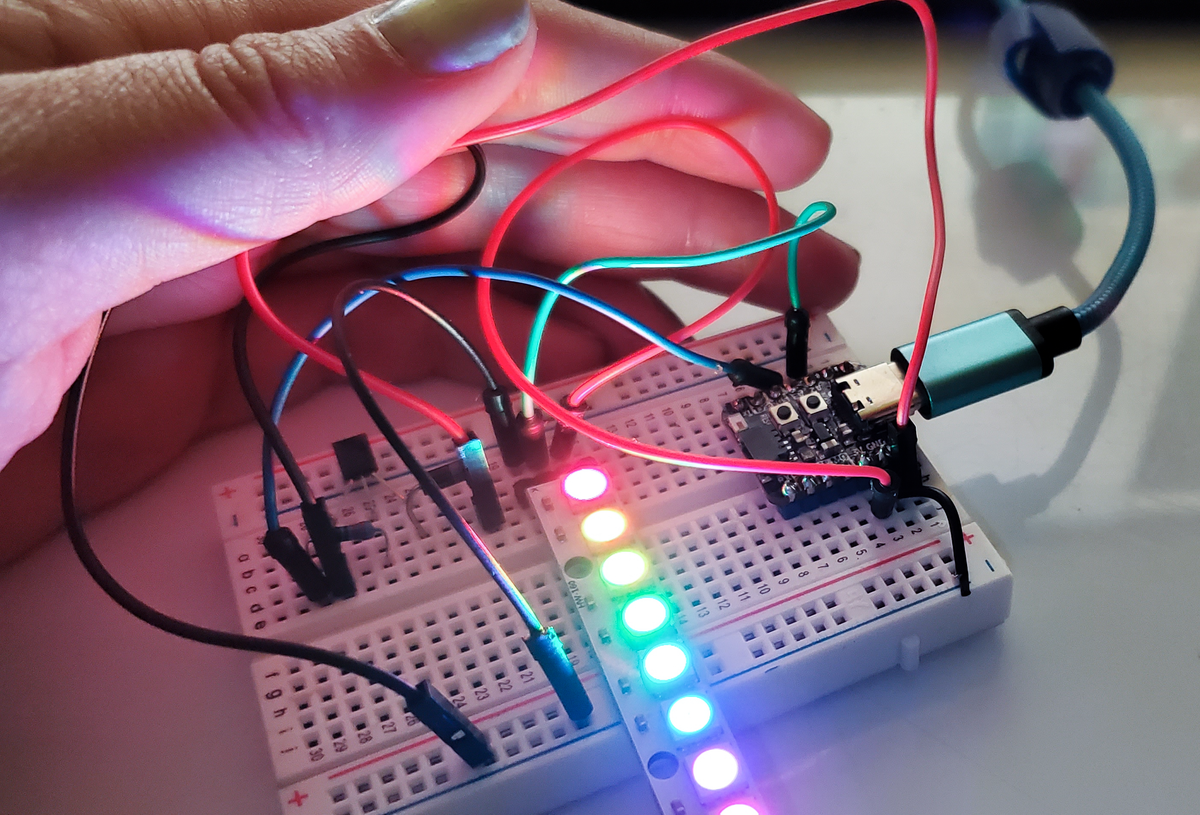
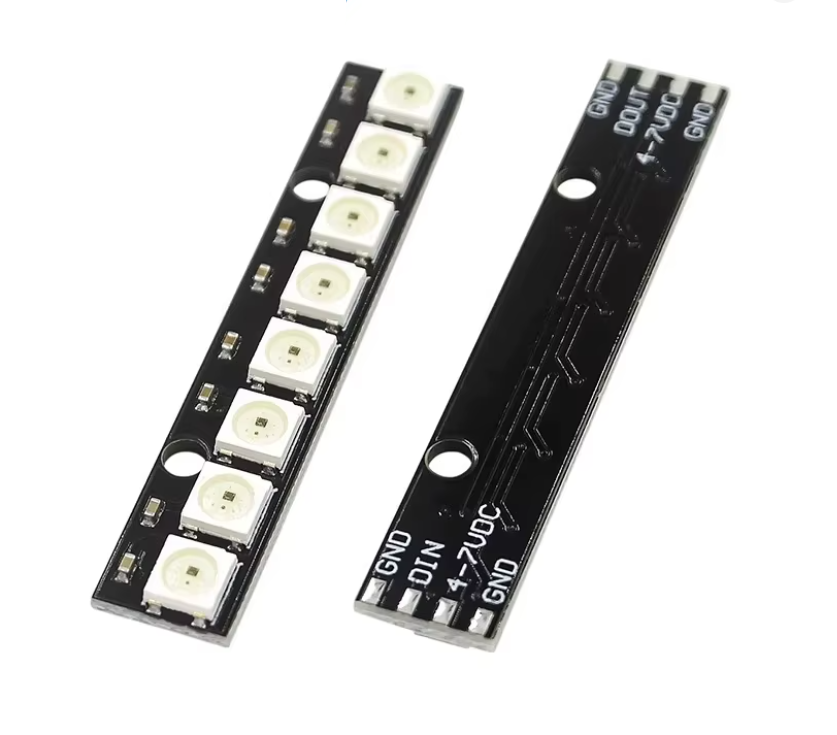
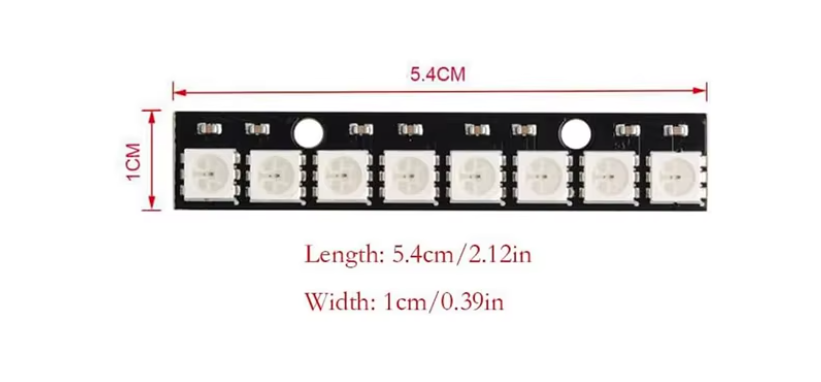
Eight addressable RGB LEDs on a compact rectangular board. The rectangle-format sibling of our WS2812 ring — every LED individually controllable from a single data pin, perfect for status bars, light-up trims, prop details, and anywhere a straight edge suits the design better than a circle. Choose a white or black board to match your project.
Ships next business day from Nova Scotia · 30-day returns · Questions? cmoz@tinkertailor.ca
Add this too


$5.75

Details
Highlights
- 8 × WS2812 addressable RGB LEDs, individually controllable
- One data pin drives the whole module — chainable via DIN/DOUT pads to add more
- 5V power, works with the FastLED and Adafruit NeoPixel libraries
- Plays nicely with ESP32, Arduino, and other 3.3V/5V microcontrollers
- White or black PCB — pick the one that disappears into (or pops against) your build
Good to know
- Ships unsoldered: solder pads accept wires or header pins. It's an easy first soldering job — we have a video tutorial showing exactly how.
- Want it ready to plug in? Our Neo Tester is the same 8-LED format fully assembled by hand — headers soldered (straight or 90°), heat-shrink protected, labelled, and tested - all in Nova Scotia.
- Pair it with an ESP32 dev board and a few hook-up wires and you're animating in minutes.
Additionally, Adafruit’s NeoPixel library for Arduino supports these pixels. There is also the FastLED library, which I’ve used to get up and running quickly.
Also check out our NeoPixel Starter Strip Try Me Pack, *mini* 10 RGB Pixel Strip, and 60/meter RGB Pixel Strips.
Each LED is addressable as the driver chip is inside the LED. Each one has ~18 mA constant current drive so the colour will be very consistent even if the voltage varies, and no external choke resistors are required — making the design slim. Power the whole thing with 5 VDC (4–7 V works) and you’re ready to rock.
The LEDs are chainable by connecting the output of one stick into the input of another. There is a single data line with a very timing-specific protocol. Since the protocol is sensitive to timing, it requires a real-time microcontroller such as an AVR, Arduino, PIC, mbed, etc.
Want code for these lights without the headache? Preview your effects and copy a ready-to-run PlatformIO or Arduino sketch with the CMozGlow code generator. Learn more about the CMozGlow library.